




Tree Preservation By-law Permitting Process
What is the Tree Preservation By-law?
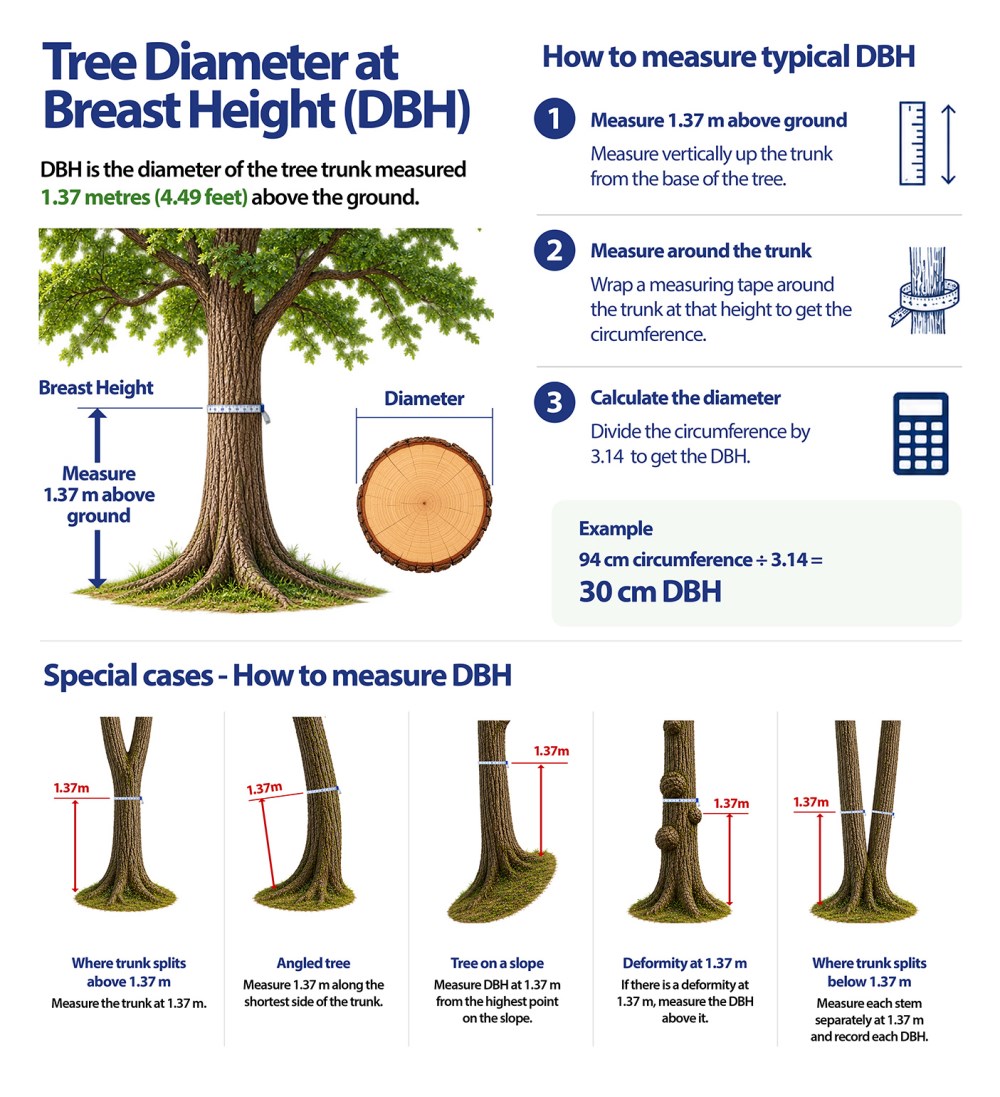
Trees within the Town of Caledon are valued for the economic, social and environmental benefits they provide. To this end, the Tree Preservation By-law (2025-101) regulates the injury, removal, or destruction of trees* outside of woodlands** on private properties, that have a 30 cm or greater Diameter at Breast Height (DBH) (1.37 m above ground).
* "Tree" means any species of woody perennial plant, including its root system, which has reached, can reach, or could have reached a height of at least 4.5 metres at physiological maturity and has a DBH of at least 30cm. For clarity, where multiple stems grow from the same root system, the number of Trees shall be the number of stems that can be counted at a point of measurement 1.37 metres from the highest point on the ground touching the trunk.
If your tree(s) meets the above definition, has a DBH of 30cm or more, and is not exempt under the By-law, you need a Tree Permit before removing or injuring the tree(s). For full definitions, refer to the By-law.
If the DBH of your tree is less than 30cm, do not submit a Tree Permit application. In cases like this you may proceed to remove the tree and while replacement trees are not required, the Town encourages and appreciates any replacement planting.
**If you are planning to remove a tree(s) within a woodland, please visit our Woodland Conservation By-law page.
The Woodland Conservation By-law is administered by the Town’s Municipal Law Enforcement department. Email enforcement@caledon.ca for Woodland Conservation By-law inquiries. Do not submit a Tree Permit application for trees that are within a woodland. If you are unsure as to whether the tree is in a woodland, email naturalheritage@caledon.ca.
How do I measure DBH?
How do I know whether my tree is exempt from a Tree Permit?
- The By-law (Sections IV & V) lists various exemptions. If you are confident that the exemption criteria apply, follow the process listed for each criteria, or where there is no process listed, you may proceed to injure or destroy the tree.
- If you are uncertain whether the exemptions apply, email your inquiry to naturalheritage@caledon.ca or phone 311 from within Caledon.
- The most common exemptions include trees that are dead or have less than 30% of their crown left, and hazardous trees. The condition and hazard status of the tree may be difficult to determine without arborist input. If there is any uncertainty as to whether these exemptions apply, email your inquiry to naturalheritage@caledon.ca or submit a Tree Permit application.
My tree is 30cm DBH or more, and not exempt - How do I apply for a permit?
Applications are required as of January 1, 2026. Application fees do not currently apply.
You can apply online or download a printable version of the application form.
What do I need to complete the application?
A few quick tips to complete the application form:
- If you are not the registered property owner and/or share a tree with a neighbour (i.e. the trunk of the tree is on the property line), you will need to obtain consent from these parties before submitting the application form.
- We’ll need the following information on each tree: the common name (e.g. Sugar Maple, White Pine, etc.); the botanical name if you know it (e.g. Acer saccharum, Pinus strobus, etc.); the DBH (diameter at breast height) in centimeters measured at 1.37m above ground (see graphic above); the condition of the tree; the action to be taken (i.e. injuring or destroying the tree) and whether it’s a shared tree.
- You’ll need to provide a plan, sketch or aerial image showing the location(s) of the tree(s) to be removed. Number the trees if there are more than one and ensure that the numbers match the corresponding numbers on the application form.
Do I require an arborist's opinion for every permit application?
- You do not necessarily have to hire an arborist to provide input as part of the application, however, the Town may request an Arborist Opinion or Report if deemed necessary. Any Arborist Opinion or Report would be at your own expense.
- The following scenarios provide examples of when the Town may request an Arborist Opinion or Report – if one is requested, staff will provide a request explaining what the Arborist Opinion or Report should contain:
- It is unclear whether more than 70% of the crown is dead.
- There is a discrepancy in the health assessment of the tree(s).
- It is unclear whether the tree meets the definition of a Hazardous Tree as defined in the By-law.
- You may also choose to hire an arborist to assist you with the required information as outlined in the application form and voluntarily submit an Arborist Opinion or Report. E.g. if you are unsure of the species, or you cannot measure DBH by yourself, and you need assistance.
Compensation requirements
- Replacement trees are required under the By-law for all trees that are injured or destroyed. The number of replacement trees is calculated based on the DBH of the tree being injured or destroyed. Once an application has been reviewed, the Inspector will confirm the number of replacement trees required.
- Replacement trees are to be planted on-site wherever feasible. This will be evaluated and discussed with you during the application review process. Cash in Lieu of replacement trees is only available as an alternative where site-specific constraints prevent on-site planting.
- While there is currently no application fee, note that securities are required for replacement trees planted on site. Securities will be returned once a Town Inspector has confirmed that the trees are in acceptable health and condition – this is typically one growing season after planting the tree(s).
- To assist applicant in choosing replacement trees, the Town has developed a list of preferred trees:
- Staff will typically require you to choose the replacement trees prior to issuing the permit, however the trees do not need to be planted before the permit is issued. The By-law allows for replacement trees to be planted up to three years after the permit has been issued.
Call before you cut!
-
If you are unsure as to whether your tree requires a permit, please contact us before you injure or remove it. Dial 311 from within Caledon or email us at naturalheritage@caledon.ca.
-
Note that if you make a wrong decision based on the exemption criteria, you may be subject to enforcement action.
-
Tree removal within the Niagara Escarpment Plan area may be subject to additional requirements. Contact the Niagara Escarpment Commission.
-
If the tree you want to remove is wholly or partially located on Public Property, please fill out our Report a Problem online form or call Service by dialing 3-1-1 from within Caledon.
Frequently Asked Questions
| Does the Tree Preservation By-law apply to dead or hazard trees? |
| Dead Trees or Hazardous Trees (as defined in the By-law) are exempt from requiring a Tree Permit. However, should you not be entirely certain that a tree(s) is dead or meets the By-law definition of a Hazardous Tree, please contact us at naturalheritage@caledon.ca or call 311 from within Caledon. The Town may require you to hire an arborist to confirm the status of the tree. |
| Where do I report a By-law violation related to trees? |
| If you have a concern related to tree removal, you can submit a complaint to Municipal Law Enforcement, email enforcement@caledon.ca or call 3-1-1 from within Caledon. |
| How much money will the permit cost per tree? |
| As of January 2026, there is no application fee. However, this may be revised in future. The Fees By-law will be updated to reflect the current fee if fees are being charged. Also note that refundable securities for replacement trees may be required as part of the application. |
| Will I need a permit to remove an invasive species tree? |
| Regardless of whether a tree species is invasive, any tree that meets the criteria for a permit as specified in the By-law will require a permit prior to injury and/or removal. |
| I share the tree with my neighbour - who needs to apply for the permit? |
| The person wanting to remove a tree on a property line must follow the instructions as per the application form. If you’re unsure who owns a tree, refer to a property survey or contact an Ontario Land Surveyor. Note that Boundary Trees fall under the legal provisions of the Ontario Forestry Act (https://www.ontario.ca/laws/statute/90f26) and it is landowner’s responsibility to ensure compliance with that Act. |
| I want to prune a tree(s), do I need a permit? |
| A permit is not required to prune dead branches if it is done in accordance with Good Arboricultural Practices (i.e., is done the proper way so it doesn’t harm the tree). Similarly, you don’t need a permit to remove/prune live branches for purposes of maintaining structural stability and balance and encouraging natural form as long as you don’t remove more than one-third of the live branches within a three-year pruning cycle or as appropriate for the species, in order to maintain the health of the tree. Refer to the definition of Maintenance Pruning and Good Arboricultural Practices in the By-law. |
| Do I need a permit to plant a tree? |
| You do not need a permit under the Tree Preservation By-law to plant a tree(s). |
|
I have an issue with the Town’s street tree – who do I contact? |
| The Town’s Operations Department is responsible for planting, maintaining and otherwise managing trees in the municipal right of way, along boulevards, streets and in municipal parks. If you have concerns with an existing Town-owned tree or you would like to have trees planted in your neighbourhood, please submit a ticket at Report a Problem or call Service Caledon at 3-1-1 from within Caledon. |
Contact Us
 Subscribe to this page